What Is Royalty Tokenization? How Blockchain Is Changing Music Investment
The phrase "tokenized music royalties" has started appearing regularly in fintech and music industry coverage, but the underlying concept is still unfamiliar to most people outside of cryptocurrency circles. This article breaks down what tokenization actually means in the context of music rights, how it works technically, and why it matters for both artists and investors.
What does "tokenization" mean?
Tokenization is the process of representing ownership of a real-world asset as a digital token on a blockchain. The token is not the asset itself — it is a cryptographic record of ownership that lives on a distributed ledger and can be transferred, divided, or tracked without relying on a single central authority.
Think of it like this: when a company issues shares of stock, it is essentially tokenizing ownership of that company. Each share represents a fractional claim on the company's assets and earnings. Public stock markets make those shares tradeable and their ownership verifiable. Blockchain tokenization does something conceptually similar, but for a much wider range of assets — including things like real estate, invoices, art, and, increasingly, music royalties.
The difference from traditional securities is that blockchain tokens exist on a decentralized ledger, meaning ownership records are public and auditable, transactions settle in minutes rather than days, and the underlying rules governing the token (including how royalty distributions are calculated and paid) can be enforced automatically through code — what the industry calls smart contracts.
How music royalty tokenization works in practice
When Ripe tokenizes a music catalog, the process involves several steps.
First, the rights to a catalog are legally structured so that investors holding tokens have a defined, enforceable claim on a portion of that catalog's future royalty income. The legal framework varies by jurisdiction, but the core principle is that each token represents a pro-rata share of whatever royalties the catalog generates.
Second, those rights are encoded into a smart contract on a blockchain. The smart contract specifies how royalties will be collected, how they will be allocated among token holders, and on what schedule distributions will occur. Once deployed, the smart contract executes automatically — no human has to manually calculate and send payments.
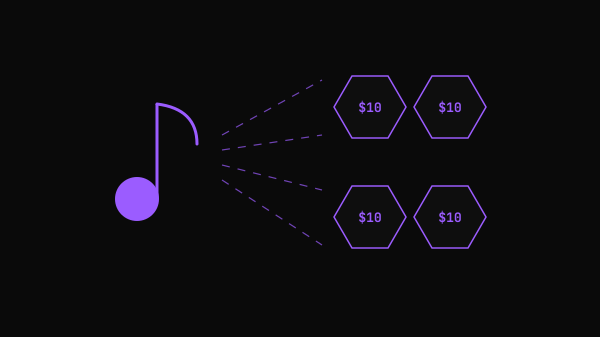
Third, the tokens are made available for investors to purchase through the Ripe platform. Investors can browse available catalogs, review historical streaming data, and buy tokens representing their desired level of exposure. The minimum entry on Ripe is $10, which means investors can start with very small positions and scale up as their confidence grows.
Fourth, as the songs in the catalog are streamed on Spotify, Apple Music, YouTube, and other platforms, royalties flow into the catalog pool. The smart contract then distributes those royalties to token holders in proportion to their ownership stake. On Ripe, this happens weekly — dramatically faster than the traditional six-month-or-longer settlement window of the conventional music industry.
Why smart contracts matter for this
The use of audited smart contracts is not just a technical detail — it is one of the most important features of a well-designed royalty tokenization platform.
Smart contracts remove discretion from the distribution process. The rules about how royalties are calculated and distributed are written into code and enforced automatically, without any individual or organization being able to alter or delay them. This is particularly meaningful in an industry that has a long history of payment disputes, opaque accounting, and delayed distributions.
Smart contracts also create an auditable record. Every royalty receipt and every distribution is recorded on the blockchain and is publicly verifiable. Investors do not have to simply trust the platform's word that distributions are being handled correctly — they can verify it independently.
Ripe's smart contracts are independently audited by third parties before deployment, providing an additional layer of assurance that the code behaves as documented.
What this means for artists
For artists, tokenization offers a new way to monetize their catalog without permanently surrendering their rights to a label or publisher. An artist can tokenize a portion of their royalty stream — say, 30% of the royalties from a specific catalog — sell that stake to investors through Ripe, and receive immediate capital upfront. They retain the remaining 70% of royalties and continue to receive that portion of streaming income indefinitely.
Importantly, Ripe is designed so that artists become co-investors rather than simply sellers. They maintain a stake in their own catalog's success and remain economically connected to their music's ongoing performance. This is a fundamentally different relationship from a traditional label deal, where an artist may receive an advance but surrender significant long-term royalty rights in return.
What this means for investors
For investors, royalty tokenization solves several problems that previously made music royalties difficult to access.
Low minimums.
Traditional royalty acquisition typically requires hundreds of thousands or millions of dollars to access meaningful positions. Tokenization allows fractional ownership, lowering the minimum to whatever the platform sets — in Ripe's case, $10.
Transparency.
Historical streaming data, royalty income history, and distribution records are available to investors before and after they invest, rather than being locked inside opaque fund structures.
Speed.
Weekly distributions replace quarterly or annual settlement cycles, meaning investors receive income much more frequently.
Liquidity potential.
While music royalty tokens are not as liquid as publicly traded stocks, the tokenized format creates the technical infrastructure for secondary markets where tokens can be traded between investors — something not easily possible with traditionally structured royalty investments.
What to look for in a tokenization platform
Not all royalty tokenization platforms are equal. Investors evaluating platforms in this space should ask a few key questions.
Are the smart contracts audited? Code that has not been independently reviewed is a meaningful security risk. Reputable platforms commission third-party audits and make the results available.
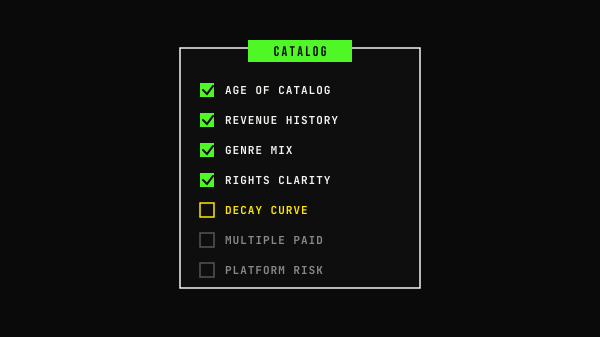
How is the catalog selected and priced? Platforms that are transparent about their methodology for evaluating catalog quality and setting token prices give investors a much stronger basis for decision-making than those that offer little explanation.
What are the legal rights of token holders? Tokenization without a clear legal framework for what the token represents in terms of real-world rights can leave investors in an ambiguous position. The best platforms structure their tokens as legally enforceable claims.
How is the royalty collection infrastructure managed? Streaming royalties pass through multiple parties before reaching rights holders. Understanding how the platform manages this collection process — and how potential delays or shortfalls are handled — is important.
The bottom line
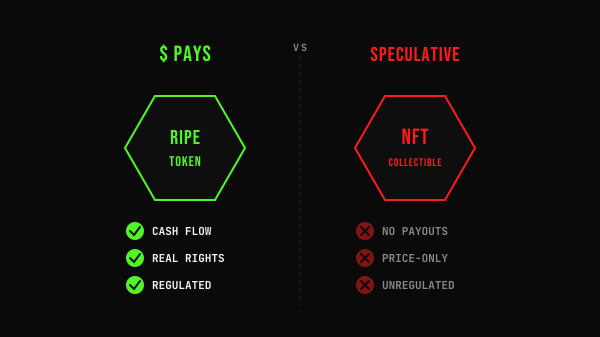
Royalty tokenization is not just a novelty or a buzzword. When implemented well, it genuinely solves real problems in music royalty distribution: slow payments, high minimums, opacity, and lack of access for retail investors. By combining the legal structure of royalty ownership with the technical capabilities of smart contracts, platforms like Ripe are creating a new category of accessible, transparent, income-generating investment.
As with any investment, please review all terms and risk disclosures before investing. Past performance does not guarantee future results.