Music Royalty Investing vs the Stock Market: A Correlation Analysis
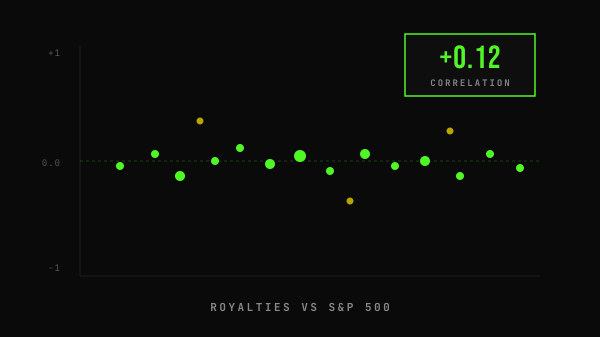
Every alternative asset class claims it's uncorrelated with stocks. Real estate, art, vintage watches, farmland — they all walk into the room with the same pitch. Some are right. Most are right only until a crisis large enough to correlate everything. The honest question for music royalties is: how does this asset behave when equities behave badly, and is that behavior reliable enough to pay for in opportunity cost? Here's what the 2020–2025 data shows.
The 'low correlation' claim — where it comes from
The strongest empirical case for music royalties as a diversifier comes from three independent sources, all converging on similar numbers:
- WIPO (World Intellectual Property Organization). In its 2025 Creative Industries Insights report, WIPO described returns from music rights as having a 'seemingly low correlation with cyclical trends in the overall economy', specifically because consumer streaming demand is largely inelastic to recessions.
- Academic backtest published in 2026. Researchers found that 'Life of Rights' (LOR) music assets, held over 5 years, produced risk and return characteristics comparable to S&P 500 stocks, but with negligible correlation to equity returns.
- Northleaf Capital and EY (2025). Both institutional analyses describe music royalty cash flows as 'noncyclical' and 'remarkably inelastic' to broader market volatility, citing the COVID-19 stress test as the key example.
The mechanism is simple: people don't stop streaming music in a recession. Consumer behavior data from MusicWatch shows US per-capita spending on recorded music actually rose to $112 in 2024, up nearly 10% from $102 in 2023, even as discretionary spending in many other categories softened.
2020–2025: what actually happened
March 2020 — COVID crash
S&P 500 dropped ~34% peak-to-trough in five weeks. During the same period, global recorded music revenue grew 7% year-over-year, driven entirely by streaming. Live music revenue collapsed (concerts went to zero), but the streaming-heavy royalty pools kept paying as if nothing had happened. Catalogs with high sync exposure to live events suffered; pure streaming catalogs were largely untouched.
2022 — inflation and rate hikes
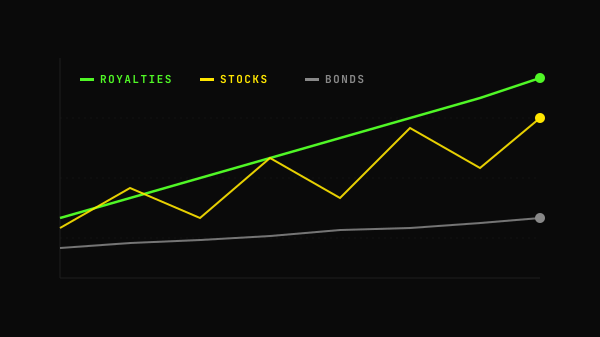
This was a brutal year for traditional 60/40 portfolios: stocks down 19%, bonds down 13%. Music royalty assets on retail platforms continued to distribute at expected yields. The 2022 mechanical royalty rate adjustment in the US actually increased streaming royalties by 44% and digital sales royalties by 32%, providing a small tailwind to publisher's-share catalogs at exactly the moment most other yield-producing assets were drawing down.
2024–2025 — institutional money arrives
By the third quarter of 2025, the music-backed bond market alone had raised $4.4 billion. Blackstone, Carlyle, and even the Michigan state pension fund participated. Concord closed a $1.765 billion ABS deal in July 2025 backed entirely by its music catalog. Whatever you think of music as a 'cool' asset class, real institutional capital with no patience for fashionable narratives is now pricing it as an income stream comparable to investment-grade corporate bonds — but with embedded equity-like upside from streaming growth.
What 'uncorrelated' actually means in practice
There's a useful distinction between three types of correlation:
- Correlation of returns. Does the price of music royalty assets move with stock prices? On retail platforms, yes — partially, because investor sentiment and liquidity affect secondary-market prices. On the underlying cash flow, no — royalty income is largely independent.
- Correlation of cash flows. Does the income produced by music catalogs rise and fall with the economy? Mostly no, in the streaming-dominant era. This is the most defensible 'uncorrelated' claim.
- Correlation under stress. How does music behave in a real crisis? The 2020 evidence is good (income held up). The 2008 evidence is largely irrelevant because streaming barely existed then. The unanswered question is what happens in a recession driven specifically by consumer income loss large enough to cause subscription churn.
Honest framing: music royalties have low correlation of cash flows with equities, near-zero correlation under recessions like 2020, and unknown correlation in deeper systemic crises. Better than 90% of alternative assets — but not magic.
Risks that don't show up in correlation math
If you sell music royalties as 'uncorrelated to stocks', you owe the reader a list of risks they trade in:
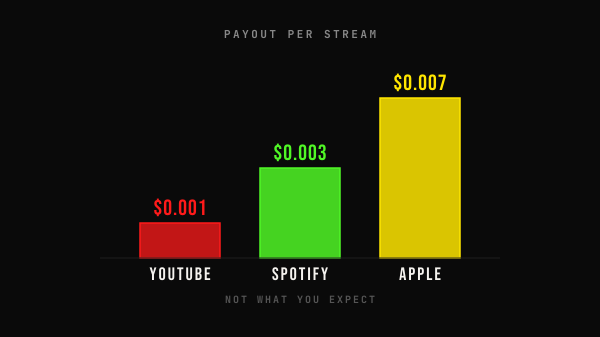
- Platform-specific risk. Streaming platforms can change payout formulas. Spotify already changed eligibility for royalty payments in 2024, demonetizing tracks under 1,000 annual streams. A future policy change could shift economics by 10–20% overnight.
- Catalog decay. Most songs lose listeners over time. A typical pop track loses 60–80% of its streams in the first 18 months. Catalogs need either evergreen tracks or active sync work to sustain income.
- AI generative music. The biggest open question in 2026. AI-generated tracks are already on streaming platforms and competing for the same listening hours. Both Spotify and Apple Music are testing labeling regimes, but the long-term economics are unclear.
- Platform liquidity. On retail royalty platforms, secondary-market trading is real but thin. If you need to exit fast, the price discount can be 10–30%. This is structural, not a flaw of any one platform.
How to size music royalties in a portfolio
The standard institutional answer (from Northleaf and similar) for sophisticated investors is 5–15% allocation to alternative income assets, with music royalties as one of several diversifiers alongside private credit, royalties on patents, and infrastructure debt.
For retail investors, the practical anchor is different: don't allocate more than you can leave invested for 3–5 years. Music royalty platforms have growing but still limited secondary liquidity. Treating them as a yield-and-hold position rather than a tradable instrument matches the actual mechanics of the asset.
FAQ
Are music royalties safer than stocks?
'Safer' is the wrong frame. The cash flows are more predictable than stock dividends, but the underlying assets have specific risks (catalog decay, platform policy, illiquidity) that stocks don't. They're different risks, not smaller risks.
What returns can I realistically expect?
Annualized 6–12% gross yield is a reasonable expectation for a diversified portfolio of mid-life catalogs, before platform fees. Returns can be materially higher for younger catalogs with active growth, and lower for legacy catalogs that act like bonds. Past performance is not a guarantee — past performance is more reliable in this asset class than in most, but it still isn't a guarantee.
How does music compare to dividend stocks specifically?
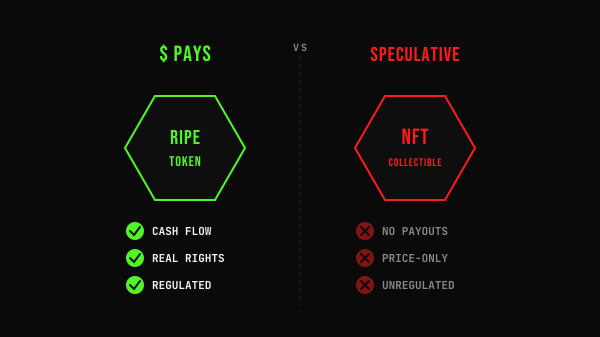
Dividend yields on the S&P 500 are ~1.5%. High-yield dividend ETFs run 3–4%. Music royalty platforms commonly distribute 6–18% on retail-accessible catalogs. Music wins on cash yield. Stocks win on liquidity and price discovery. Music wins on correlation properties. Stocks win on transparency and regulatory maturity. They aren't substitutes — they're complements.
If music is so good, why isn't everyone doing it?
Until very recently, you couldn't. The minimum check for a Hipgnosis-style fund was institutional-only. Platforms like Ripe are the first wave to make fractional, retail-sized investment realistic. The asset class is six years old in its retail form. That's the answer.