Music Royalty Investing Glossary: 30 Terms Every Investor Should Know
Administration deal
An arrangement where a third party (usually a music publisher) collects royalties on behalf of a songwriter or rights holder in exchange for a fee, typically 10–25%. The rights holder retains copyright; the administrator handles licensing, registration with PROs, and royalty collection.
ASCAP / BMI / SESAC
The three Performing Rights Organizations (PROs) operating in the United States. They license music for public performance, collect performance royalties from broadcasters and venues, and distribute the income to songwriters and publishers. ASCAP and BMI are the largest; SESAC is invitation-only.
Catalog
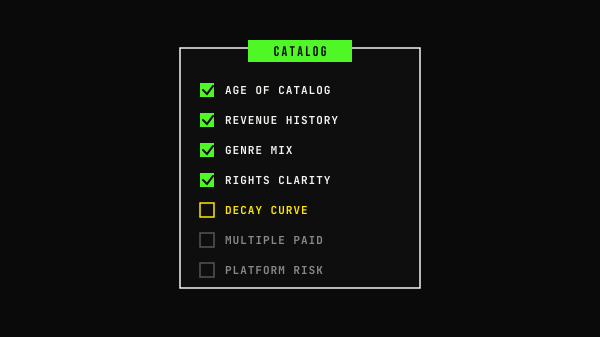
A collection of songs or recordings owned or controlled by a single rights holder. In music royalty investing, 'a catalog' usually refers to the bundle of tracks an investor buys exposure to. Catalogs vary from a single-artist back catalog to multi-artist curated portfolios.
Composition copyright
The copyright in the underlying song — its melody, harmony and lyrics — as opposed to a specific recording of the song. Owned by songwriters and (usually) administered by music publishers. Generates mechanical, performance and sync income.
DCF (discounted cash flow)
A valuation method that estimates an asset's present value by projecting future cash flows and discounting them back at a chosen interest rate. The standard tool for valuing music catalogs alongside market-multiple comparisons.
Distributor
A company that places music onto streaming platforms (Spotify, Apple Music, etc.) and collects the master-side royalty income on behalf of the rights holder. Examples: DistroKid, CD Baby, The Orchard, AWAL. Typically takes 10–30% of master royalties as a fee.
Fractional ownership
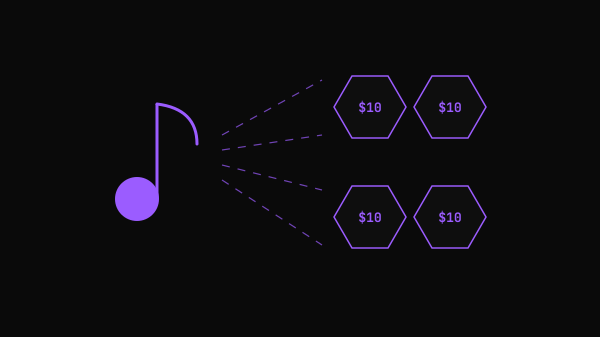
A structure where a single asset (like a music catalog) is divided into many small shares so multiple investors can each own a portion. The economic rights (royalty income) are split pro-rata; the legal copyright usually remains with a single entity.
Hipgnosis Songs Fund
The pioneering UK-listed music royalty fund founded in 2018 by Merck Mercuriadis. Hipgnosis demonstrated that music could trade as a public asset class but ultimately traded at a discount to NAV, leading to its 2024 acquisition by Concord. The reference case for institutional music royalty investing.
Life of Rights (LOR)
A royalty asset where ownership lasts for the full duration of the copyright (typically the songwriter's life plus 70 years, or 95 years for sound recordings in the US). Contrasted with shorter-term contracts (e.g. 10 years). LOR assets typically command higher valuations.
Master copyright
The copyright in a specific sound recording. Owned by whoever financed the recording — historically the record label, increasingly the artist directly. Generates the largest portion of streaming royalties (~55–70% of the streaming pie).
MLC (Mechanical Licensing Collective)
The non-profit established by the 2018 Music Modernization Act to collect and distribute mechanical royalties from US digital streaming services to publishers and songwriters. Operational since 2021. Sometimes referred to as 'the new ASCAP for mechanicals'.
Mechanical royalty
Royalty paid for the reproduction of a composition. Originally tied to physical sales (cassettes, CDs) but now primarily generated by digital streaming. The 2022 US rate adjustment increased streaming mechanical royalties by 44%.
NAV (Net Asset Value)
The estimated total value of a fund or catalog's assets minus its liabilities. Investors should compare any traded price to NAV — Hipgnosis traded at significant discounts to NAV before its 2024 acquisition, which is part of why discount-to-NAV is now a watched metric in the asset class.
NPS (Net Publisher's Share)
Royalty revenue collected by a music publisher from a composition, minus royalties paid out to songwriters and any co-publishers. The standard metric for valuing publishing assets, with market multiples typically applied directly to NPS.
NLS (Net Label's Share)
Revenue received by a record label from the exploitation of its sound recordings, less the royalty payments to artists, producers and other third parties. The standard metric for valuing master recording catalogs.
PRO (Performing Rights Organization)
A collection society that licenses music for public performance and distributes performance royalties. Major PROs include ASCAP and BMI (US), PRS (UK), GEMA (Germany), SACEM (France), JASRAC (Japan).
Pro-rata royalty pool
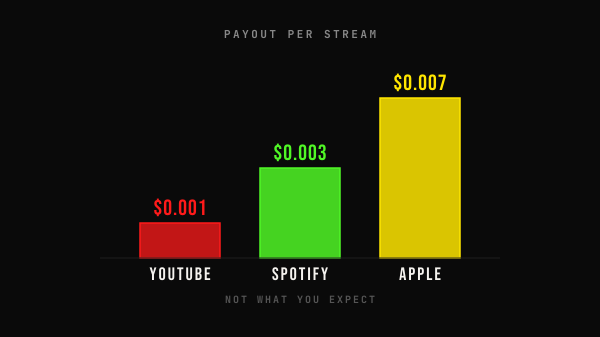
The standard royalty distribution model used by most streaming platforms. Total streaming revenue (minus the platform's keep) is pooled, then distributed to rights holders based on each track's percentage of total streams. Means individual per-stream rates vary depending on total stream volume.
Publisher
A music industry participant that administers the composition copyright on behalf of songwriters: registering songs with PROs and collection societies, licensing for sync uses, and collecting royalties. Major publishers include Universal Music Publishing, Sony Music Publishing, and Warner Chappell.
Reg A (Regulation A)
A US Securities Act framework that allows companies to make public offerings to retail investors with a lighter regulatory burden than full IPOs.
Reversion
The return of copyright ownership to the original creator after a fixed period, even if rights were previously transferred. Under US law, songwriters can reclaim composition copyrights 35 years after assignment. A risk factor for catalog investors holding US compositions over long horizons.
Securitization
Pooling income-producing assets (in this case music royalty streams) and issuing securities backed by those cash flows. The 1997 'Bowie Bonds' was the first major music royalty securitization. By 2025, the music ABS market exceeded $4.4 billion in annual issuance.
Sync (synchronization) license
A license required to use a piece of music in synchronization with visual media — film, TV, advertising, video games, social media. Sync deals are negotiated case-by-case and can range from $1,000 to several hundred thousand dollars depending on usage and scope.
Term deal
A royalty acquisition structured for a fixed period (typically 10 years) rather than for the life of the copyright. Term deals trade at lower multiples than Life of Rights deals because the buyer's exposure ends at expiration.
Tokenization
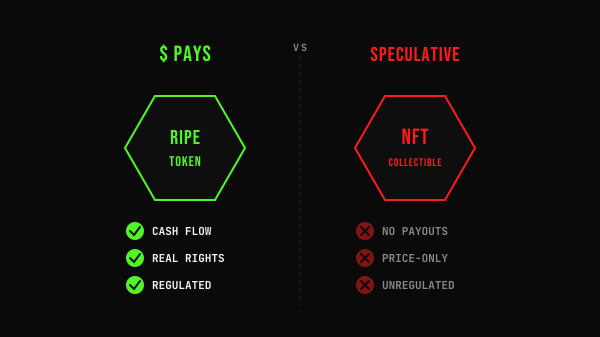
The process of representing ownership of an asset as a digital token on a blockchain. In music royalty investing, tokenization splits a catalog's income rights into many small fractional units that can be bought, held and traded on-chain.
Tokenized royalty share
A blockchain token that represents a contractual right to a portion of a music catalog's royalty income. Used by Ripe and several other platforms. The token is the record of ownership; the underlying right is a legal claim against the catalog entity.
Yield (royalty yield)
The annualized cash distribution from a royalty asset divided by its acquisition price. Different from total return, which includes any change in the asset's market value. Retail platform yields in 2026 commonly range 4–18% depending on catalog age and structure.