How to Evaluate a Music Catalog Before You Invest
Investing in music royalties is ultimately an act of underwriting — you are betting that the songs in a catalog will continue to generate streaming income at a level that justifies the price you are paying for your ownership stake. Making that bet well requires a framework for evaluating the key variables that drive catalog performance.
This guide walks through the most important factors to consider when reviewing a music catalog for investment, regardless of which platform you are using to access it.
1. Streaming consistency over time
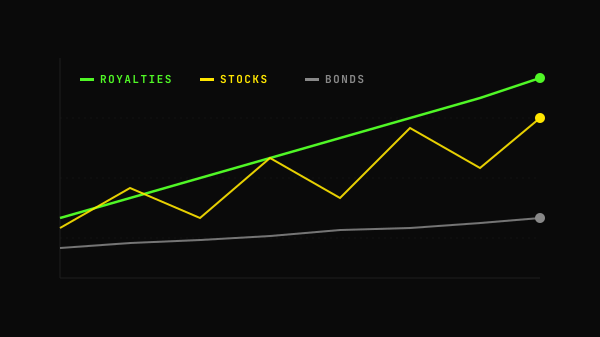
The single most important indicator of a catalog's investment quality is the consistency of its streaming performance over multiple years. A song that has maintained steady monthly streams for three or four years is a fundamentally different proposition from one that spiked after a viral moment and has since declined sharply.
When reviewing streaming data, look for:
Year-over-year stability.
Has the catalog's total annual streams grown, held steady, or declined over the past three years? Small fluctuations are normal and expected. Consistent year-over-year declines, especially steep ones, are a warning sign about the catalog's durability.
Monthly consistency within each year.
Some catalogs exhibit strong seasonal patterns — holiday music is an obvious example — while others generate relatively even monthly streams throughout the year. Understanding the pattern helps set realistic expectations for when royalty income will be higher or lower.
Recovery from dips.
Has the catalog experienced noticeable drops in streaming activity, and if so, did it recover? A catalog that has demonstrated the ability to bounce back from algorithmic changes or off-peak periods is more resilient than one that has consistently trended downward.
2. Catalog breadth and diversification
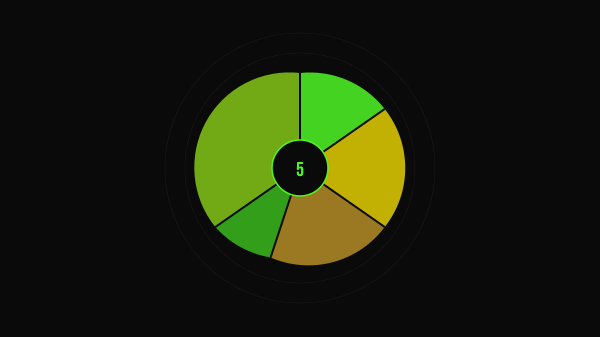
A catalog containing 20 songs across multiple sub-genres and release years is much more defensible than a catalog containing a single track, no matter how popular that track is. Diversification within a catalog reduces your exposure to any one song losing popularity or playlist placement.
Ask yourself: if the top-performing song in this catalog were to see a 50% decline in streams next year, how would that affect the catalog's total royalty income? If the answer is "it would cut income by more than half," the catalog is highly concentrated and the investment thesis depends on a single song's ongoing performance.
Also consider genre diversification. A catalog with songs across different genres — pop, hip-hop, R&B, indie, electronic — has exposure to different listener communities and different playlist ecosystems, which provides some natural hedging against genre-level trend shifts.
3. Platform and geographic distribution
Streaming royalties come from many platforms across many territories. A catalog that generates the vast majority of its streams from a single platform in a single country is more exposed to platform-specific or territory-specific risk than one with broad distribution.
Platform mix.
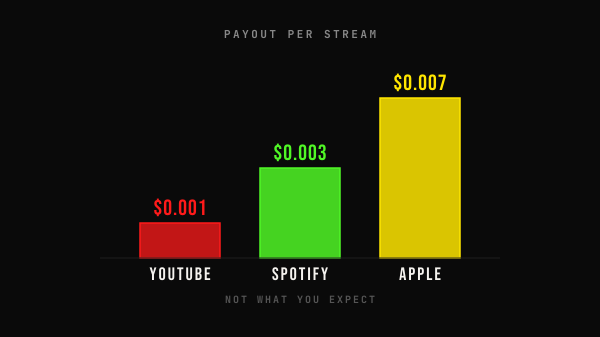
Premium audio streaming (Spotify, Apple Music, Amazon Music, Tidal) generally pays higher per-stream rates than ad-supported tiers or platforms like YouTube. A catalog that is well-represented on premium platforms has a better yield profile than one that is primarily driven by free-tier or YouTube listening.
Geographic distribution.
Streaming royalty rates vary significantly by country. Streams from markets like the United States, United Kingdom, Germany, and Australia tend to generate higher royalties than equivalent streams from markets with lower subscription penetration. A catalog with global reach, including strong performance in high-royalty territories, is more valuable than one that is geographically concentrated in lower-rate markets.
4. Playlist presence and algorithmic health
On Spotify in particular, a significant share of stream counts comes not from fans actively searching for specific songs, but from algorithmic recommendation systems (like Discover Weekly and Release Radar) and editorial playlists. Songs that are regularly featured in these surfaces maintain higher ongoing stream counts than songs that have fallen out of algorithmic rotation.
When possible, check whether the songs in a catalog are currently featured on prominent Spotify playlists. Tools like Chartmetric, Soundcharts, or Spotify for Artists (if you have access) can show current playlist placements. A song that is on dozens of active playlists has a built-in distribution network maintaining its stream counts — one that has been removed from playlists must rely on organic search and existing fan behavior, which typically yields lower volumes.
5. Artist trajectory and profile
The streaming performance of a music catalog does not exist in isolation from the artist who created it. An artist's ongoing career activity — releasing new music, touring, maintaining social media presence — has a direct impact on the streaming performance of their catalog.
An artist who continues to release new music and maintains an active fanbase is likely to bring new listeners to their back catalog as those listeners explore their discography. An artist who has been inactive for years and maintains no public presence has a catalog whose streaming performance is effectively coasting on existing recognition, with less upward potential.
It is also worth considering the artist's relationship with their audience across social media. An artist with millions of engaged followers who regularly interact with their community has a structural mechanism for driving streams that a similarly sized artist with a passive social presence does not.
6. Sync and licensing potential
While streaming royalties are the primary income source for most music catalog investments, sync licensing — the licensing of music for use in TV shows, films, advertisements, and video games — can meaningfully supplement royalty income.
Some catalogs have strong sync track records, with songs that have been placed multiple times in commercial contexts. This indicates that music supervisors and brand agencies find the music commercially appealing and broadly licensable. Catalogs with a history of sync placements have a secondary income stream that is not captured in streaming data alone.
Sync is harder to predict and quantify than streaming royalties, but it represents genuine upside for the right catalog. Assess the style and tonality of the music — is it the kind of music you might hear in a car advertisement, a streaming drama's emotional scene, or a sports broadcast? That intuition is a reasonable proxy for commercial sync appeal.
7. Valuation and implied yield
After evaluating the quality of the catalog, the final question is whether the price being asked for the tokens is reasonable given the income the catalog generates. This is where catalog valuation becomes more art than science.
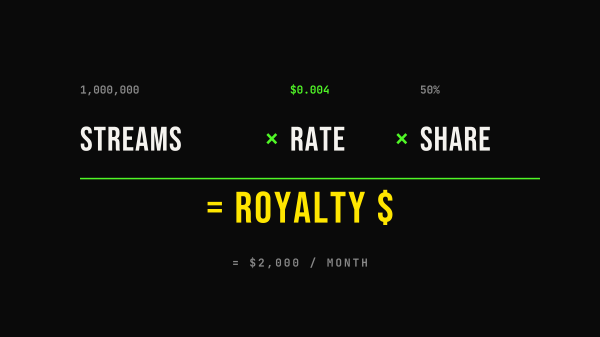
The most common valuation approach is to calculate the implied multiple of trailing twelve-month royalty income that the token price represents. If a catalog generated $50,000 in royalties over the past year and the total token market capitalization is $500,000, the catalog is priced at 10x trailing royalty income.
Whether 10x is reasonable depends on the stability and growth prospects of the underlying income stream. Stable, growing catalogs from well-known artists have historically commanded higher multiples than declining or volatile catalogs. In the broader royalty investment market, multiples have varied significantly based on interest rate environments and the competitive landscape for catalog acquisitions.
As a retail investor, the key question is not whether the multiple is at a historical high or low, but whether the catalog's income stability and growth prospects justify the multiple being asked. A high multiple on a very stable, diversifying catalog might be more defensible than a lower multiple on a concentrated or declining one.
Putting it together: a simple evaluation checklist
Before investing in any music catalog on Ripe or any other royalty platform, work through these questions:
- Has the catalog shown consistent streaming performance over at least two to three years?
- Does the catalog contain multiple songs, or is it heavily dependent on a single track?
- Is streaming performance distributed across multiple platforms and geographies?
- Are the songs in the catalog actively featured on prominent playlists?
- Is the artist still active and maintaining an engaged fanbase?
- Does the catalog have a track record of sync placements or strong commercial appeal?
- Is the implied yield from the token price reasonable given the income stability of the catalog?
No catalog will score perfectly on every dimension. The goal is to understand the specific risk-reward tradeoff of each investment and build a portfolio of royalty positions that is diversified enough to absorb weakness in any individual catalog without materially damaging your overall returns.
This guide is for informational purposes only and does not constitute financial or investment advice. All investments carry risk. Past streaming performance does not guarantee future royalty income.