How Spotify, Apple Music and YouTube Pay Royalties
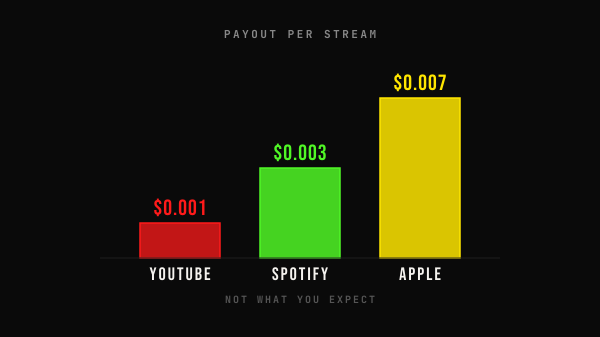
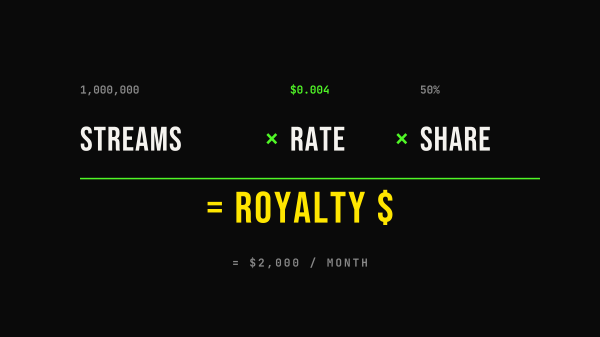
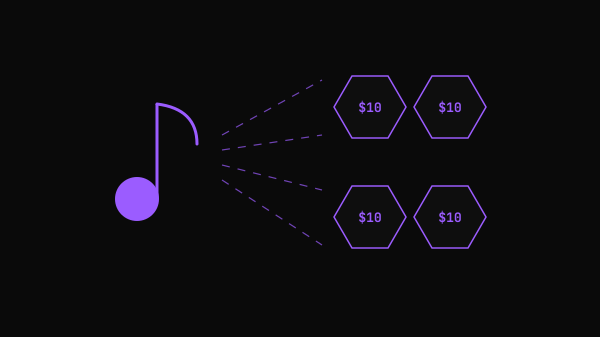
Streaming platforms don't pay 'per stream' the way most people imagine. There's no $0.0033 button that gets pressed every time someone hits play. The actual mechanism is a pool: each platform takes its monthly subscription and ad revenue, holds back its share, and distributes the rest to rights holders pro-rata based on each track's percentage of total streams. The 'per-stream rate' you read about online is just the pool divided by total streams — useful for comparison, misleading as a guarantee.
Here's how each major platform actually works in 2026.
How streaming royalty pools work (the universal model)
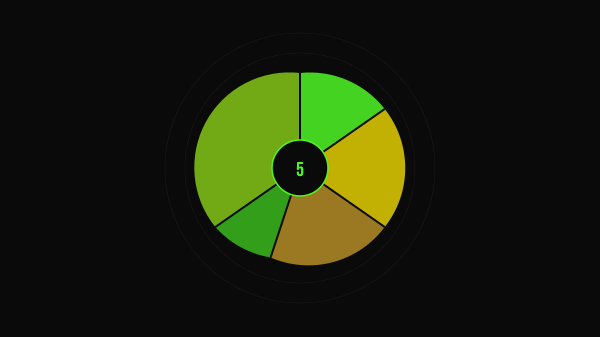
Every major streaming platform follows the same five-step process:
- Collect total revenue for a given period (subscription fees + ad revenue, by country).
- Subtract the platform's keep (typically 30%).
- The remaining 70% becomes the 'royalty pool' for that period.
- Calculate each rights holder's share: their tracks' streams / total streams on the platform that period.
- Pay the rights holders' share, split by predetermined contracts between labels (master), publishers (composition) and PROs (performance).
This pro-rata model has one important consequence: when total streams grow faster than total revenue, the per-stream rate falls — even though the platform hasn't 'cut' anyone's pay. This has been happening slowly since 2020, especially on platforms with growing free tiers.
Spotify
- Average payout per stream (2025): $0.003–$0.005 on premium tier; $0.001–$0.002 on ad-supported tier.
- Payout cycle: monthly to labels and distributors. Labels then pass through to artists on their own (usually quarterly) cycle.
- Major 2024 policy change: tracks must accumulate at least 1,000 plays in the trailing 12 months to qualify for any royalty payment. This was Spotify's response to AI-generated 'royalty farming' and significantly affected long-tail catalogs.
- Discovery Mode: rights holders can opt tracks into algorithmic boosting in exchange for a 30% reduction in the royalty rate. Useful for new releases, debatable for catalog tracks.
For investors, Spotify's economics matter most because it dominates streaming volume globally. A typical streaming-heavy catalog generates 50–70% of its income from Spotify alone. Catalog selection should always include a check: how exposed is this catalog to a single platform's policy changes?
Apple Music
- Average payout per stream (2025): $0.007–$0.010. Notably higher than Spotify.
- Why higher? No free ad-supported tier (every play comes from a paying subscriber) and a slightly more favorable royalty pool split.
- Payout cycle: monthly.
- Notable: Apple Music publishes a transparent royalty rate target of '$0.01 per stream' as a marketing point. The actual number varies by country and time, but this commitment is industry-leading.
Apple Music is smaller than Spotify in subscriber count, but its revenue contribution per catalog can rival Spotify's because of the higher per-stream rate. Catalogs popular among Apple's user demographic (older, more affluent, US-skewed) often perform disproportionately well there.
YouTube and YouTube Music
YouTube is two products from a royalty perspective:
- YouTube Music (subscription): comparable to Spotify Premium. Per-stream rate around $0.008.
- YouTube ad-supported (the main product): much lower, $0.001–$0.002 per view, depending on ad fill rates and country.
YouTube's ad-supported tier is the largest legal source of free music streams in the world. It pays poorly per view but at vast scale. For a catalog with viral potential or strong fan-driven engagement, YouTube can be the largest single revenue source — the math works because of volume.
Two YouTube-specific income streams worth noting:
- Content ID: automated royalty collection when other users upload videos containing your music. For a popular track, Content ID income can equal or exceed direct video royalties.
- YouTube Shorts: since 2023, eligible music tracks earn from a separate Shorts royalty pool. The mechanics are still evolving but increasingly important for newer catalogs.
Smaller but important platforms
Tidal HiFi
Per-stream rate $0.011–$0.013 — the highest of any major platform. Subscriber base is small (a few million globally), so absolute contribution is limited, but for catalogs popular with audiophile or hip-hop audiences, Tidal can punch above its weight.
Amazon Music
Per-stream rate ~$0.004, similar to Spotify Premium. Three tiers (Free, Prime, Unlimited) with different pool dynamics. Strong in the US and Germany; growing in Latin America.
Deezer
Per-stream rate ~$0.0064. Smaller globally but dominant in France and parts of Latin America. Notably, Deezer pioneered an 'artist-centric' royalty model in 2024 that pays artists with under 1,000 monthly listeners less and 'professional' artists more — a different policy response to the same AI/spam problem Spotify addressed differently.
What's changed in 2024–2026
- AI-spam crackdown. Spotify (1,000-stream threshold), Deezer (artist-centric model), Apple Music (labeling requirements). All three are reactions to AI-generated tracks gaming pro-rata royalty pools. Net effect on legitimate catalogs: small positive, because pool dilution is reduced.
- Subscription price increases. Spotify raised Premium prices twice in 2024–2025 (US: $9.99 → $11.99 → $12.99). Apple Music followed. Per-stream rates have risen modestly as a result, even though pool size growth has slowed.
- Mechanical royalty rate adjustment. The 2022 rate increase (44% on streaming, 32% on digital sales) is now fully phased in. Publishers and songwriters benefit; this also means publisher's-share catalogs have seen a modest tailwind.
- Sync data integration. Major platforms now report sync placement metadata more consistently, which has improved the speed of sync royalty collection by 30–50% for participating publishers.
What this means for catalog economics
If you're evaluating a catalog on Ripe or any other platform, ask three questions:
- What's the platform mix? A catalog with 80% Spotify exposure is more vulnerable to Spotify policy changes than one with 40% Spotify, 25% Apple, 25% YouTube, 10% other.
- Is the catalog above the 1,000-stream Spotify threshold? On younger or smaller catalogs, this matters. On established catalogs, every track is comfortably above.
- How is sync income trending? Sync is the most volatile and highest-margin income source. A catalog with rising sync placements is structurally improving even if streaming income is flat.
FAQ
Why do per-stream rates vary so much?
Three main reasons. First, pro-rata pools mean rates depend on total streams in a given period. Second, country-level revenue varies enormously (US streams pay 5–10× more than Indian streams in the same pool). Third, free vs paid tier streams pay different rates because the underlying revenue is different.
Does the artist actually get the per-stream rate?
Almost never. A label-signed artist typically receives 15–25% of the master share; an indie artist might receive 50–80%. The 'per-stream rate' published online is the gross amount before any of these splits.
Which platform pays best for catalog investors?
Apple Music has the highest per-stream rate, but Spotify's volume usually means more total income from the same catalog. Tidal pays best per stream but has limited reach. The right answer is platform-diversified catalogs, not platform-picking.
Will streaming rates rise or fall in the next 5 years?
Likely modest rises in absolute terms (more subscription price increases, more emerging-market subscriber growth) but pressure from AI dilution. Net direction is unclear. Most institutional models assume flat-to-slightly-rising real rates through 2030.