Music Royalties vs. Stocks and Bonds: How They Compare as Investments
Most investors are familiar with the standard portfolio building blocks: stocks for growth, bonds for income and stability. But the concept of allocating a portion of a portfolio to alternative assets — real estate, commodities, private credit, or royalties — has moved from institutional strategy to mainstream conversation as investors look for ways to diversify income sources and reduce correlation to public markets.
Music royalties are one of the more distinctive alternatives available today. This article compares music royalty investments to stocks and bonds across the dimensions that matter most to investors: income, risk, correlation, and accessibility.
Income: regular cash flows from a defined source
Bonds
pay a fixed interest rate on a defined schedule until maturity, when the principal is returned. The income is highly predictable because the terms are set at issuance. The risk is primarily credit risk (will the issuer default?) and interest rate risk (will rising rates reduce the market value of the bond?).
Dividend stocks
pay variable income that is entirely at the discretion of the company's board. Dividends can be cut or eliminated at any time, and the income is secondary to the stock's total return profile. Stock prices are driven by earnings growth expectations, not income yield.
Music royalties
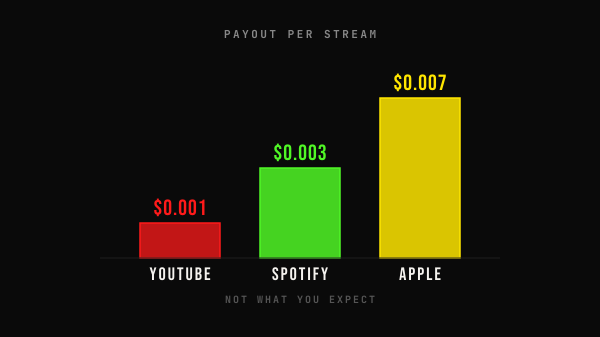
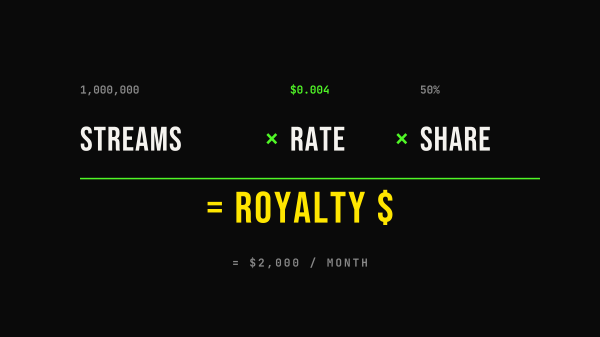
pay income that is tied directly to streaming activity — a real-world behavior that is measurable and ongoing. The income is not fixed like a bond coupon (it varies with streaming performance), but it is also not entirely discretionary like a dividend. If the songs in a catalog are streamed, the royalties flow. The income is event-driven, not decision-driven.
For income-focused investors, royalties offer an interesting middle ground: more variable than a bond but more fundamentally grounded in real activity than a dividend stock. On Ripe, royalty distributions are made weekly, providing a regular income cadence that many investors find appealing.
Risk profile: what can go wrong
Every asset class has its own risk profile, and honest evaluation requires understanding the specific risks of music royalty investing alongside those of traditional assets.
For stocks,
the main risks are business risk (the company underperforms or fails), market risk (the broad market declines, taking most stocks down with it), and valuation risk (the stock was overpriced relative to future earnings). Stock investors are essentially long on the future earnings power of a business.
For bonds,
the main risks are credit risk (the issuer defaults), interest rate risk (rising rates decrease bond prices), and inflation risk (fixed coupon payments lose real purchasing power over time). Investment-grade bonds are considered relatively safe, but the tradeoff is modest income in normal rate environments.
For music royalties,
the specific risks are:
Streaming performance risk.
If an artist falls out of favor, if their catalog loses playlist placement, or if listener behavior shifts, streaming counts and royalty income can decline meaningfully.
Platform risk.
Streaming royalty rates are not guaranteed and can change as platforms renegotiate with rights organizations. In the long term, the streaming landscape could shift toward models that generate different royalty structures.
Concentration risk.
A small catalog built around one or two popular tracks has more single-point-of-failure exposure than a large, diversified catalog.
Liquidity risk.
Music royalty tokens are not as liquid as publicly traded stocks or bonds. Selling a position may take more time and effort than selling a stock on an exchange.
Investors considering music royalties should be comfortable with these specific risks and size their positions accordingly.
Correlation: the case for true diversification
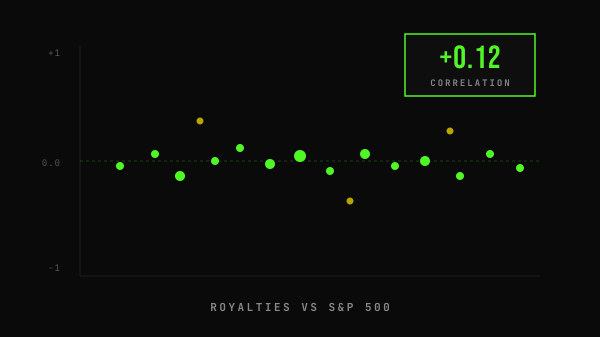
One of the most-discussed features of music royalties as an asset class is their low correlation to traditional financial markets. To understand why this matters, it helps to think about what "correlation" means in a portfolio context.
A highly correlated portfolio — one where all assets move up and down together — does not actually reduce an investor's risk just because it contains many line items. If everything falls by 30% in a market downturn, it does not help to have divided that exposure across 20 funds instead of one. True diversification requires assets that respond to different underlying drivers.
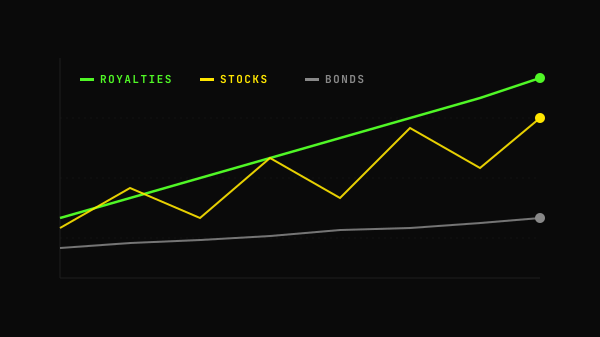
Music royalties are driven by listening behavior. When people stream music, they generate royalty income. That behavior does not stop because interest rates rise, because a recession begins, or because a technology sector correction wipes value off equity portfolios. The primary driver of royalty income — people listening to music — is relatively stable across economic cycles.
This does not mean royalties are risk-free or counter-cyclical. An economic recession might cause some listeners to downgrade from premium streaming subscriptions, potentially affecting per-stream rates slightly. But the fundamental driver of royalty income (listening behavior) is far more insulated from macro volatility than corporate earnings, credit spreads, or equity valuations.
Accessibility: who has historically been able to invest
Stocks and bonds
are broadly accessible to retail investors through brokerage accounts. Index funds and ETFs have made it extremely easy to own diversified exposure to both asset classes at very low cost. This accessibility is a significant advantage of traditional investments.
Music royalties
have historically been far less accessible. Direct catalog acquisition — buying the rights to a music catalog outright — requires industry relationships, legal expertise, and typically millions of dollars in capital. Royalty-focused investment funds have existed for institutional investors, but minimum commitments are usually high and lock-up periods long.
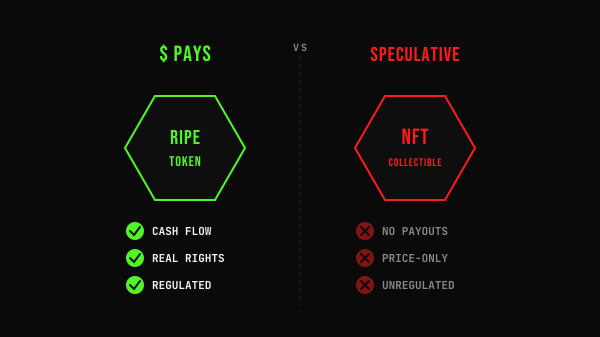
Tokenized royalty platforms like Ripe change this equation by fractionalizing ownership and lowering the minimum investment to as little as $10. This is a meaningful shift in who can participate in music royalty income streams.
A side-by-side comparison
How music royalties fit into a diversified portfolio
Music royalties are not a replacement for stocks or bonds — they are a complement to them. For investors who want genuine diversification of their income sources and are comfortable with the specific risks of royalty investing, a small allocation to music royalties can reduce overall portfolio correlation to public markets and add a regular income stream tied to a different underlying driver than anything else they may own.
The appropriate allocation size depends on the individual investor's goals, risk tolerance, liquidity needs, and overall portfolio composition. As with any alternative investment, investors should not concentrate more in music royalties than they can afford to hold without needing to sell, given the lower liquidity compared to public markets.
This article is for informational purposes only and does not constitute financial advice. Please review all risk disclosures before investing on the Ripe platform.