What Are Music Royalties? A Plain-English Guide for Investors

Every time a song plays on Spotify, Apple Music, or YouTube, money changes hands. That money is called a royalty — a payment made to whoever holds the rights to that music. For most of streaming's history, those payments have flowed almost entirely to major record labels, large music publishers, and a small class of specialized institutional investors. But that is changing.
This guide explains how music royalties work, where the money comes from, who collects it, and why royalties have become an increasingly interesting asset class for investors who want real cash flows with low correlation to the stock market.
Where royalty money comes from
When a song is streamed, the streaming platform (Spotify, Apple Music, Amazon Music, Tidal, etc.) pays out a portion of its subscription and advertising revenue as royalties. These royalties are then distributed to rights holders through a complex chain involving collection societies, distributors, and label agreements.
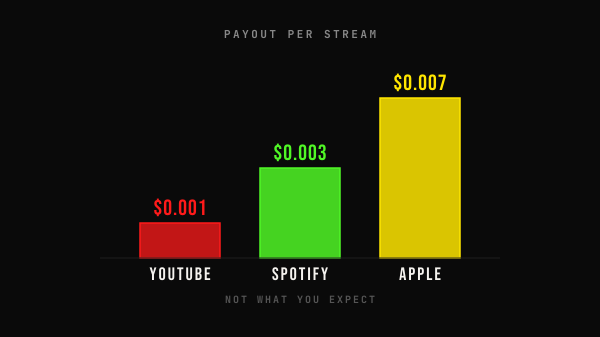
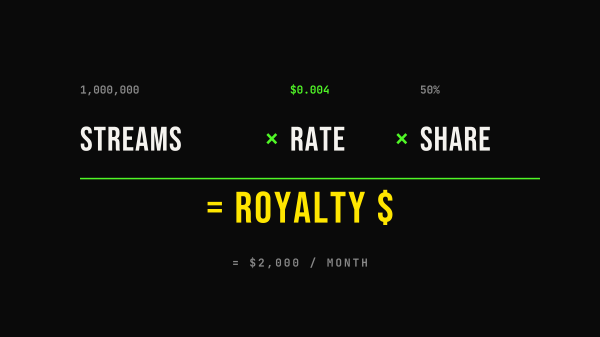
The exact per-stream rate varies by platform, territory, and the listener's subscription tier, but the key point is this: every stream generates a small payment, and popular songs with large, loyal audiences generate a very large number of streams. A track with one hundred million streams per year is producing a meaningful and relatively predictable income stream.
The two main types of music royalties
Master recording royalties are paid to whoever owns the master recording of a song — typically the original record label or, in some cases, the artist themselves. These are the royalties paid when someone streams the recorded version of a song that you know and recognize. They are what most investment products in the royalty space are based on, because they are tied to a specific, identifiable recording with a trackable streaming history.
Publishing royalties (or composition royalties) are paid to the songwriter and music publisher for the underlying composition — the melody and lyrics — regardless of which artist records or performs the song. A song that has been covered by many artists, or licensed for use in a TV show or advertisement, can generate substantial publishing royalties independent of streaming performance.
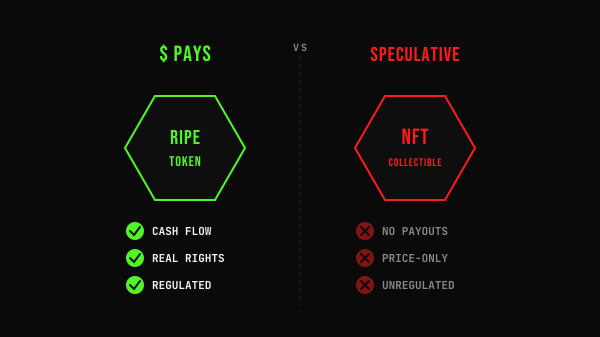
Most music royalty investment products, including those available through platforms like Ripe, are primarily structured around master recording royalties because they are easier to quantify, track, and predict based on historical streaming data.
How royalties are collected and distributed
In most markets, royalties are collected by performing rights organizations (PROs) and music distributors who aggregate payments from streaming platforms and distribute them to rights holders. The process has historically been slow: it is not uncommon for royalties to take six months or more to flow from a streaming platform through the collection and distribution chain to the actual rights holder.
This is one of the reasons blockchain-based royalty platforms like Ripe have attracted attention. By tokenizing royalty rights and using smart contracts to automate distribution, it is possible to collapse that settlement window from months to days or weeks.
Why music royalties interest investors
Music royalties have several properties that make them attractive as a portfolio asset, particularly for investors looking for income and diversification.
Recurring cash flows.
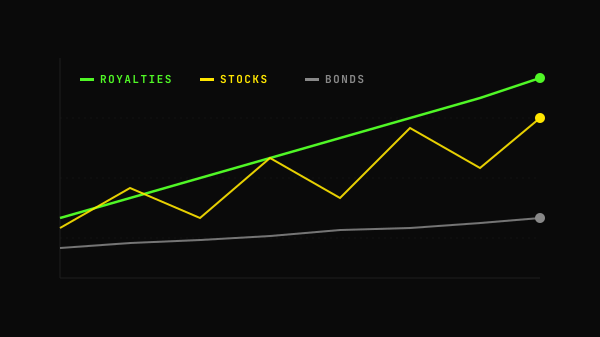
Unlike a stock that pays dividends only if the company chooses to, a well-performing music catalog generates royalties continuously as long as people stream the songs. The income is not discretionary on the part of any single company — it flows automatically from listener behavior on the world's major streaming platforms.
Low correlation to public markets.
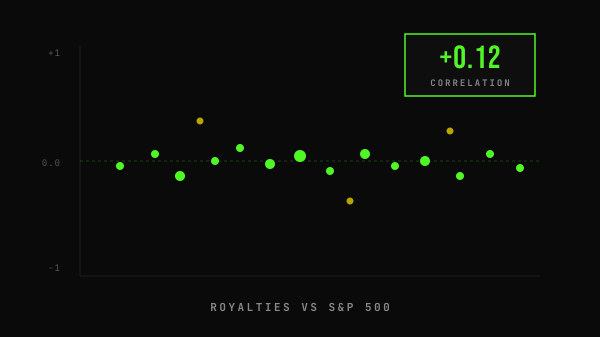
People stream music whether the stock market is rising or falling. Music royalty income is tied to cultural consumption patterns and the growth of the streaming economy, not to corporate earnings cycles, interest rate changes, or equity market sentiment. This makes royalties a genuine diversifier, not just a repackaged version of something investors already own.
Growing underlying market.
The global recorded music market has grown significantly over the past decade, driven primarily by streaming. While past growth does not guarantee future results, the structural shift from piracy and physical media to paid streaming subscriptions represents a long-term tailwind for royalty income.
Data-driven evaluation.
Unlike many alternative assets, music royalties come with detailed, publicly accessible performance data. Streaming counts, listener demographics, geographic distribution of plays, and historical royalty income are all available and auditable, making it possible to evaluate a catalog with more precision than is typical in alternative investments.
What are the risks?
No investment is without risk, and music royalties are no exception.
Streaming performance can decline. An artist's popularity can fade, or their catalog can fall out of algorithmic rotation on major platforms, reducing the number of streams and the resulting royalty income. A catalog that performed well in the past may not perform well in the future.
Royalty rates are not fixed. Streaming platforms periodically renegotiate their royalty payout rates with rights holder organizations, and those negotiations can result in changes to per-stream payments. Regulatory changes in key markets can also affect royalty collection.
Concentration risk is real. A catalog built around a small number of tracks, or a single artist's popularity, is more exposed to a single point of failure than a diversified portfolio of many songs across many genres and artists.
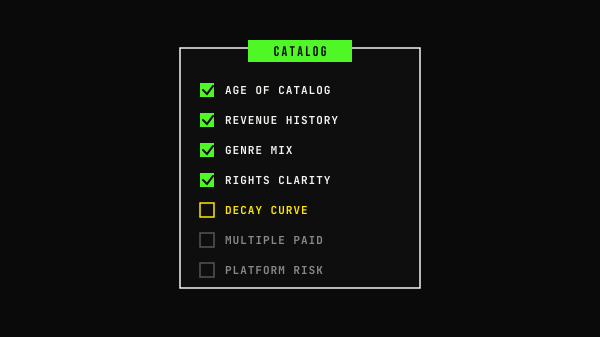
For investors considering music royalty products, a key question is how diversified the underlying catalog is, how transparent the historical performance data is, and how clearly the platform explains its methodology for selecting and pricing assets.
Getting started
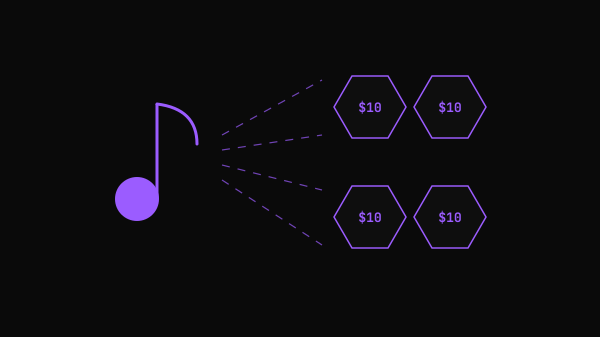
Historically, investing in music royalties required either deep industry connections, direct relationships with artists and rights holders, or significant capital to access institutional-grade royalty acquisition funds. The emergence of tokenized royalty platforms has begun to democratize this access — allowing investors to participate in music royalty income streams with lower minimums, more transparency, and faster distributions than traditional structures allowed.
Ripe Capital was built specifically for this purpose: to make music royalty investing as accessible, transparent, and straightforward as possible for anyone who wants to participate.
As with any investment, you should review all available information and consider your personal risk tolerance before investing in music royalties or any other asset class. Past performance does not guarantee future results.