Are Music Royalties a Good Investment in 2026?
'Are music royalties a good investment in 2026?' is the most-searched question in this asset class right now. The honest answer is: yes, for some investors, in some sizes, with eyes open about three specific risks that didn't exist two years ago. Here's the long version.
The short answer
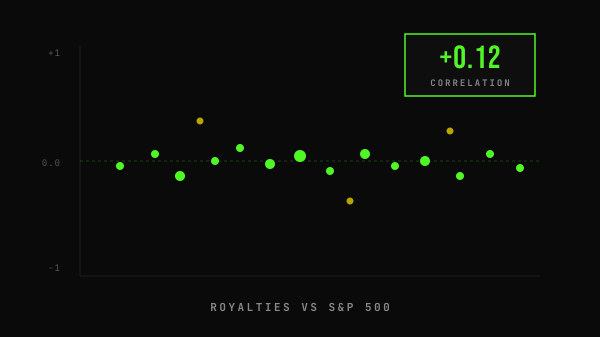
Music royalties are a legitimate yield-producing alternative asset with low correlation to public equities, retail-accessible from $10 on platforms like Ripe, and increasingly validated by institutional capital — Blackstone, Carlyle, the Michigan state pension fund and several major insurers all participated in over $4.4 billion of music-backed bond issuance in 2025 alone.
They're a poor fit if you need quick liquidity, refuse to tolerate income volatility, or expect the platform you invest through to behave like a stock brokerage. They're a good fit if you want diversified yield, can hold for 2–5 years, and accept that royalty income is bumpy month-to-month even when it's stable year-to-year.
What's true in 2026 that wasn't true two years ago
1. Retail access is real
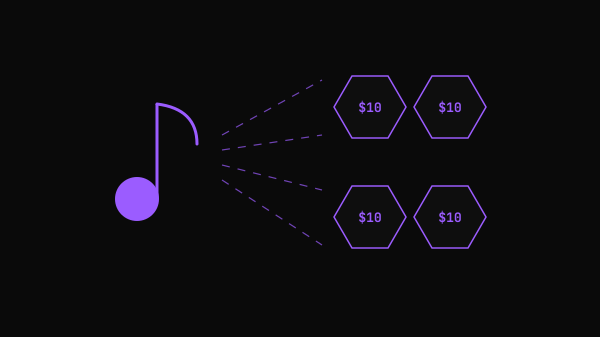
In 2024, fractional music royalty investing for non-accredited investors was an experiment. By 2026, multiple platforms accept retail capital, with minimums ranging from $10 (Ripe) to several hundred dollars. The plumbing works. The legal structures are battle-tested.
2. Streaming economics have stabilized
US recorded-music revenue hit $17.7 billion in 2024, with streaming at 84% of that. Global market reached $105 billion in 2024 and is projected to reach close to $200 billion by 2035, growing at roughly 6% annually. The growth is no longer speculative — it's a base case, and the base case is good for catalog economics.
3. Institutional capital has priced the asset class
This is the most important shift. When Blackstone and Carlyle commit billions to music royalty securitization, the asset class is no longer a curiosity. It has comparable infrastructure, ratings (Moody's, Fitch and S&P all rate music ABS deals), and pricing benchmarks to investment-grade corporate bonds. For a retail investor, this is the equivalent of buying real estate after REITs became standard — the asset is the same, but the market around it is now mature.
Three types of investors music suits well
Yield-seekers in their 30s–50s
If you have a long enough horizon to hold 3+ years, and you're tired of 4% money-market funds, music royalty catalogs offer 6–18% gross yield with low equity correlation. Allocating 3–8% of total investable assets to a basket of catalogs is a reasonable starting point — enough to matter, small enough that illiquidity doesn't hurt.
Diversifiers
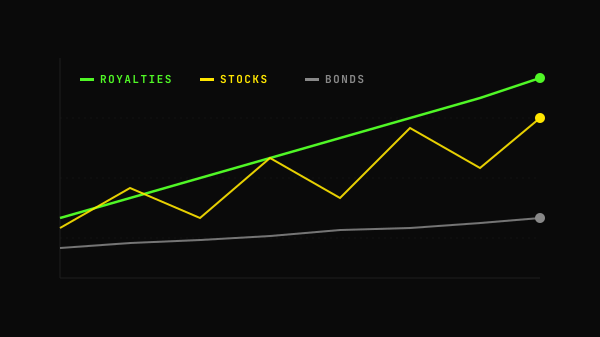
If you already have a 60/40 or all-stocks portfolio and you want a real diversifier, music royalties do what gold pretends to do: produce uncorrelated income that holds up in 2020-style downturns. The cash flow is real, not metaphorical. This is the case Northleaf, Empower and several institutional allocators are making in 2025–2026.
Music-adjacent retail investors
If you understand music — you DJ, you collect, you work in the industry, you have strong taste — your information edge in picking catalogs is real. You'll spot a sync-heavy electronic catalog with under-monetized potential before someone reading a backtested model does. This advantage is rare in equity markets but real in music.
Three types of investors music suits poorly
Anyone with under 6 months of emergency savings
Music royalty positions can be exited on secondary markets, but at a discount during stress periods. This is not the asset to own when you might need the money in 90 days.
Investors who panic at variable monthly income
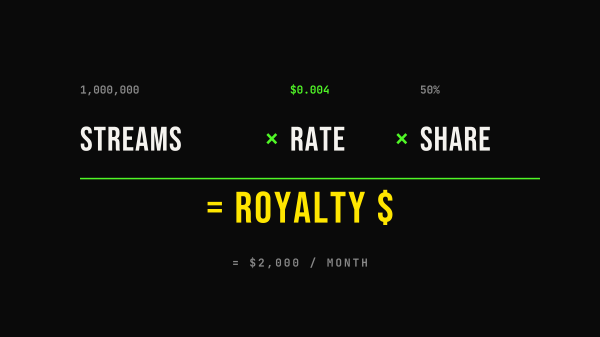
A catalog might pay $230 one week and $90 the next. Quarterly averages are stable; weekly cash flows are bumpy. If you'll obsess over a 30% week-over-week dip in royalty income (which is normal), this asset will frustrate you.
Investors who want price discovery, not income
Music royalty tokens have prices, but the price is not the point. The point is the cash flow. If you're optimizing for capital appreciation, public equities offer cleaner price discovery. If you're optimizing for yield with diversification, music wins.
New risks specific to 2026
1. AI-generated music
This is the largest open question in the asset class. AI-generated tracks now occupy a measurable share of streams on Spotify and YouTube. Both platforms have begun labeling regimes, and Spotify's 2024 royalty changes (demonetizing tracks below 1,000 annual streams) were partly aimed at AI spam — but the long-term economic impact is unclear. A reasonable base case: AI compresses the long tail of catalogs but doesn't materially affect curated catalogs of established artists. Bear case: AI dilutes the royalty pool meaningfully over 5–10 years.
2. Streaming rate compression
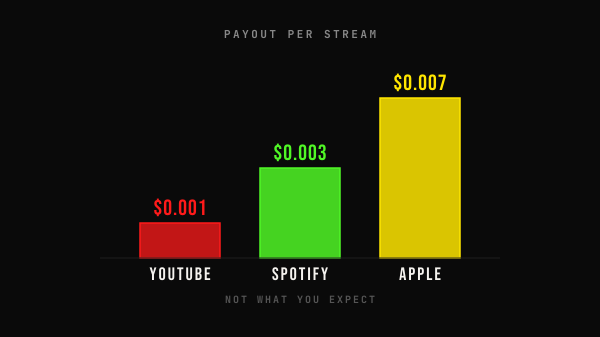
As subscriber growth slows in mature markets (US, UK, Western Europe), per-stream rates may compress further. This is partly offset by emerging-market subscriber growth and price increases (Spotify raised premium prices twice in 2024–2025), but it's a structural drag investors should factor in.
How to start without overcommitting
- Decide your total alternative-asset allocation. 5–15% of investable assets is the standard range for sophisticated investors.
- Of that, allocate no more than 30–50% to music royalties on day one. Treat it as a real position, not a token bet.
- Diversify across at least 2-3 catalogs of different vintages and genres. Concentration risk is real — a single catalog could underperform regardless of the asset class.
- Plan to hold for 2–5 years minimum. The income compounds; the correlation benefit only shows up across cycles.
- Re-evaluate annually. As the market matures, expect yields to compress as institutional money continues to enter.
FAQ
What's the smallest amount that makes sense?
On Ripe, the technical minimum is $10. Practically, $200–1000 lets you spread across 2-3 catalogs and feel the diversification effect.
Can I lose money?
Yes. A catalog can underperform projections. Streaming rates can drop. A platform can have operational issues. Music royalties are an asset class with real risks, not a savings product. The fact that institutional money has entered doesn't change that — it just means the risks are now better understood.
How does this compare to crypto?
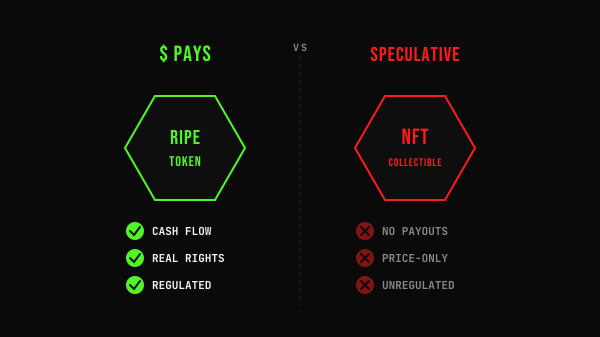
Different category entirely. Crypto is an asset class where returns come from price appreciation and speculative demand. Music royalties produce income from real-world activity (people listening to songs). The blockchain layer is shared, but that's like saying real estate and luxury watches are similar because both are 'physical assets'. The economic mechanics are unrelated.