How Are Music Royalties Calculated? A Plain-English Guide
If you're new to music royalty investing, the first question is usually the most uncomfortable: where does the money actually come from? You hear that a song earns income when it's streamed or played on the radio, but the chain from a Spotify play in Berlin to a payout in your wallet is opaque on purpose — there are five intermediaries, two copyrights, and at least four different types of royalty involved. This guide walks through all of it without the jargon.
The two copyrights you need to know first
Every recorded song you hear has two separate copyrights, and they generate two separate streams of royalty income. This is the single most important concept in music investing, and almost every misunderstanding starts here.
- The composition copyright (also called publishing rights). This protects the song itself: melody, lyrics, harmony. It belongs to the songwriter and, usually, to a music publisher who administers it. When a song is streamed, performed, or used in a film, this copyright generates income that flows to writers and publishers.
- The master copyright (also called sound recording rights). This protects a specific recording of the song. It belongs to whoever financed the recording — historically the record label, increasingly the artist directly. Each individual recording (the original, a cover, a remix) is a separate master.
The same song can generate income on both copyrights at the same time. When 'Levitating' plays on Spotify, Dua Lipa's master earns money, and the songwriters and publishers who hold the composition copyright also earn money. They are paid through different pipelines and at different rates.
On Ripe, the catalogs you invest in are typically tied to one of these copyrights — most commonly publisher's share of the composition, because it's the more stable and predictable of the two.
The four types of royalty income
Every dollar of music royalty income falls into one of four categories. Understanding this matters because the proportions tell you a lot about the risk profile of any catalog.
1. Streaming royalties (the largest bucket)
In 2024, streaming accounted for roughly 84% of all recorded-music revenue in the US — about $14.9 billion of the $17.7 billion total. So when we talk about music as an asset class today, we're mostly talking about streaming.
Streaming generates two royalties at once on every play:
- A mechanical-style royalty for the composition (because each stream technically reproduces the song).
- A performance royalty for the composition (because each stream is a public performance).
- A master royalty for the recording (which is by far the largest of the three — typically ~55–70% of the streaming pie goes to the master holder).
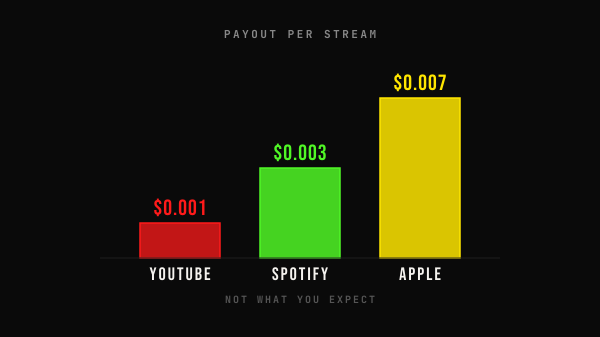
The actual per-stream rate depends on the platform, the country and the listener's subscription tier. Industry averages in 2025 hover around:
- Spotify: $0.003–$0.005 per stream
- Apple Music: $0.007–$0.010 per stream
- YouTube Music: $0.001–$0.002 per stream (free tier) and ~$0.008 (premium)
- Tidal HiFi: $0.011–$0.013 per stream
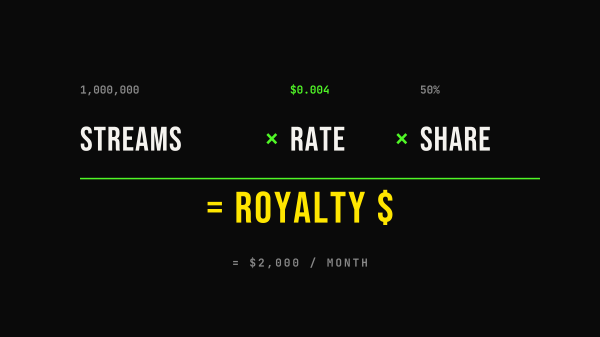
These look small until you multiply them by scale. A track with 1 million streams a month generates roughly $3,000–$5,000 in gross royalties — split many ways, but the catalog as a whole earns it predictably, every month.
2. Public performance royalties
Whenever a song is played in public — radio, bars, restaurants, gyms, hold music in a call center, a concert venue — the composition copyright generates a performance royalty. Collection is handled by Performing Rights Organizations (PROs): ASCAP and BMI in the US, PRS in the UK, GEMA in Germany, SACEM in France, and so on.
PROs license bulk usage to broadcasters and venues, then redistribute the money to publishers and songwriters based on usage data (radio reports, set lists, sample monitoring). The cycle from a play to a payout typically takes 6–18 months — one of the reasons traditional music royalty income feels so disconnected from real-world activity.
3. Sync licensing
When a song is paired with visual media — a film, a TV show, an ad, a video game, a TikTok template — the licensee pays a synchronization fee plus an ongoing royalty. Sync deals are negotiated case-by-case, and one well-placed sync can transform a catalog's economics overnight. The standard reference point is Kate Bush's 'Running Up That Hill' going back to #1 in 30+ countries after appearing in Stranger Things in 2022.
Sync income is the most volatile of the four categories, but also the highest-margin. A single sync placement on a major TV show can pay $25,000–$200,000 upfront, plus performance royalties whenever the show is broadcast or streamed.
4. Mechanical royalties (physical and digital sales)
These are paid every time a copy of the song is reproduced — vinyl press, CD, paid digital download. The category has shrunk dramatically (it's now ~9% of recorded music revenue in the US), but vinyl has had a real second life: $1.4 billion in 2024 sales, up from near zero a decade earlier. For older catalogs with cult followings, mechanicals from vinyl reissues can be a meaningful line item.
Who pays whom: the royalty value chain
Here's the typical path of $1 generated by a stream on Spotify:
- Spotify keeps roughly 30% of the gross subscription revenue.
- The remaining 70% goes into a 'royalty pool' and is distributed pro-rata based on stream share.
- Of the distributed amount, ~55–65% goes to master holders (labels or independent artists).
- ~10–15% goes to publishers (composition, mechanical and performance combined).
- The remaining 5–10% goes to PROs and collection societies.
- Each of those entities deducts their administration fee (typically 10–25%) and passes the net to the rights holder.
On a tokenized music royalty platform like Ripe, the catalog you invest in sits at the rights-holder end of this chain. You don't see the Spotify-to-label transfer — you see the net royalty that hits the catalog's collection account every week, and your share is calculated and distributed automatically.
A worked example: $100 of royalties from 50,000 streams
Let's make this concrete. Imagine an indie pop track that's getting 50,000 streams a week across Spotify, Apple Music and YouTube. Conservatively that generates ~$220 of gross royalties. After Spotify-equivalent fees and platform deductions, the rights-holder receives roughly $130. From that:
- $80–95 goes to the master holder (label or artist).
- $25–35 goes to the publisher and songwriter.
- $5–10 goes to PROs and collection societies.
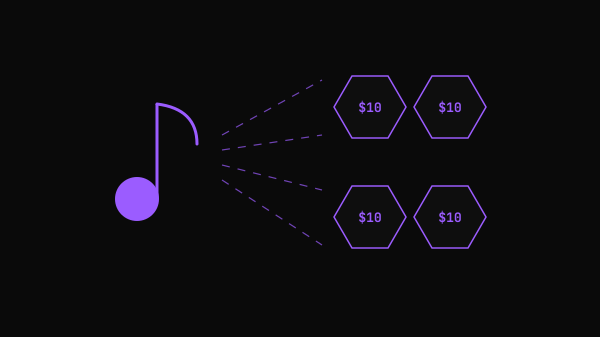
Now imagine you own 10% of the publisher's share of that song through a tokenized catalog. Your weekly cash flow from this single track is roughly $2.50–$3.50 — small in isolation, but a portfolio of 50–200 such tracks behaves like a yield-bearing asset with very predictable distributions.
Why this matters for investors
The most important takeaway: music royalty income is not one thing. A catalog's resilience depends on the mix. A catalog dominated by streaming income is exposed to streaming-rate compression and platform policy changes. A catalog with significant sync revenue can spike unpredictably (good for upside, hard to forecast). A catalog with public-performance income through PROs has the slowest, smoothest cash flow.
When you look at a Ripe catalog like 'Ripe Growth' or 'Ripe x B4 Sounds', the historical royalty mix is shown alongside total earnings. Read that mix the same way you'd read a P&L breakdown for a small business — it tells you what the catalog is, structurally, before any forecast.
FAQ
How often are music royalties paid out?
Streaming platforms report play counts monthly. Labels and publishers typically distribute to rights holders quarterly. PROs settle even less frequently, often semi-annually, with up to a 12-month lag. Modern platforms like Ripe aggregate, forecast and distribute weekly using machine learning, so you don't wait months for income that's technically already been earned.
What's the typical yield on music royalties?
Industry data from 2025 puts annualized yields on retail music royalty platforms in the range of 8–20% for younger catalogs, and 4–7% for mature 'life of rights' catalogs that act more like long-duration bonds. Wide range — driven entirely by catalog age, genre and rights structure.
Do I own the songs when I invest?
No. In every retail platform, including Ripe, you own a contractual right to a portion of the income — not the copyright itself. You don't own a piece of 'Halo' or any specific song. You own a fractional claim on the royalty stream the catalog produces. This is a feature, not a bug: it means you take economic exposure without inheriting the legal complexity of copyright administration.
Can royalty payments go down?
Yes. A catalog's royalty income depends on continued listening, playlisting, sync placements and platform pricing. Streams can decline, songs fall out of editorial playlists, and sync income is lumpy by nature. Past performance is informative but not predictive. This is why diversification across many catalogs matters more in music royalties than in many other alternative assets.